
IFRS vs US GAAP: Key Differences Every Business and Finance Professional Must Know
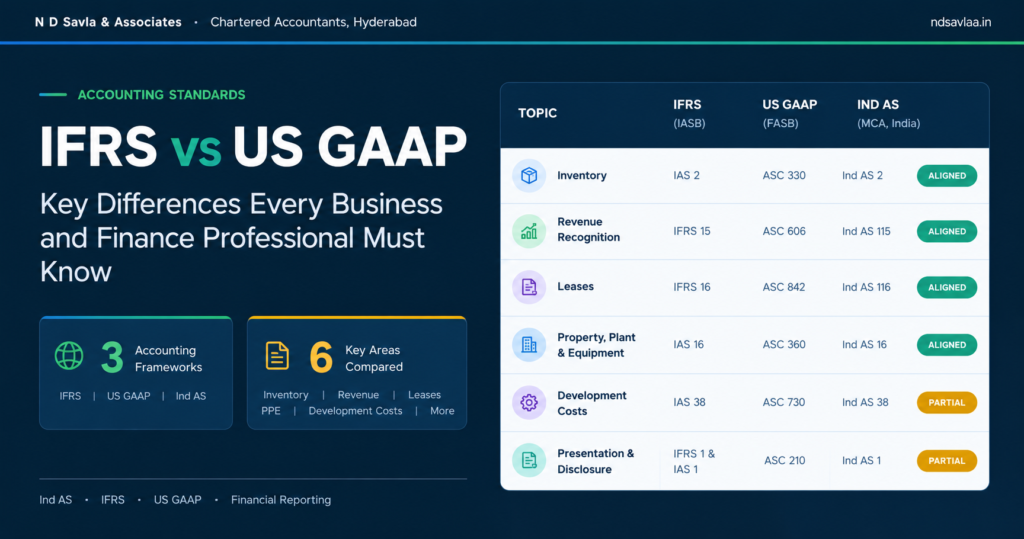
Accounting Standards IFRS vs US GAAP: Key Differences Every Business and Finance Professional Must Know A complete comparison for Indian businesses — inventory, revenue, leases, PPE, development costs, and exactly how Ind AS fits into the picture. Author N D Savla & Associates Published 18 September 2026 Category Accounting Standards Read time — min 3 frameworks compared 13 major topic areas ~50% carry a material difference LIFO: permitted under US GAAP, prohibited under IFRS & Ind AS Revenue recognition: aligned across all three Lease accounting: single model vs two models In short IFRS is principles-based, US GAAP is rules-based, and Ind AS — India’s IFRS-converged framework — follows IFRS’s principles with specific India carve-outs. The two dominant global standards agree closely on revenue recognition and goodwill, but diverge materially on inventory (LIFO), leases, development costs, and PPE revaluation — differences that directly affect reported profit and equity for Indian IT, pharma, and manufacturing businesses with cross-border reporting obligations. Frameworks Comparison Principles vs Rules Inventory Revenue Leases Costs & PPE History Who Acts FAQ IFRS vs US GAAP is one of the most searched accounting topics among Indian finance professionals — and for good reason. As India integrates further with global capital markets, as Indian companies seek listings on US exchanges, and as growing tech and pharma sectors attract foreign direct investment from both US and European companies, understanding the key differences between these two dominant accounting frameworks has moved from a theoretical exam question to a daily professional necessity. For Indian finance professionals and business owners, this topic carries an added layer of complexity: India does not follow IFRS directly, nor does it follow US GAAP. Instead, the Ministry of Corporate Affairs (MCA) introduced Ind AS — Indian Accounting Standards — substantially converged with IFRS but carrying specific India-relevant carve-outs. An Indian CFO or CA needs to understand where IFRS and US GAAP differ, where Ind AS aligns with IFRS, and where India’s own standards diverge from both. This guide covers all three dimensions clearly and practically — and since a new company is often where this question first comes up, it’s worth starting with a clean structure via company registration that already anticipates which framework you’ll eventually report under. 01What are IFRS, US GAAP, and Ind AS — and how does India fit in? Understanding the three-framework landscape is the essential starting point for any Indian finance professional dealing with international accounting standards. IASB · London IFRS Adopted or permitted in 140+ countries including the EU, UK, Australia, Canada and Singapore. Principles-based: broad objectives, with management applying professional judgement to specific transactions. FASB · Norwalk, CT US GAAP The SEC recognises FASB standards as authoritative for all domestic US-listed companies. Rules-based: highly detailed, prescriptive guidance for virtually every transaction type. MCA / ICAI · India Ind AS Introduced in phases from FY 2016-17 for listed and large unlisted companies (net worth above ₹250 crore). Carries the same numbering as IFRS with specific India carve-outs. Critical point for Indian readers This guide focuses on IFRS vs US GAAP. Where Ind AS aligns with IFRS — which it does in most areas — the IFRS column below also reflects Ind AS. Where Ind AS has a specific India carve-out, that’s called out explicitly. On this page Three-framework landscape Full comparison table Principles vs rules Inventory, revenue & leases Costs, PPE & goodwill History & who needs to act Need a GAAP reconciliation? Our team prepares US GAAP reconciliations and Ind AS gap analyses for Hyderabad businesses. Talk to us → 02IFRS vs US GAAP vs Ind AS: three-way comparison Aligned Partial / structural Material difference The table below compares the three frameworks across every major accounting topic area. The Ind AS column is the most practically useful reference for Indian finance professionals. Topic area IFRS US GAAP Ind AS (India) Status Standard setter IASB (London) FASB (USA) MCA / ICAI Structural Framework style Principles-based Rules-based Principles-based (IFRS-converged) Structural Jurisdictions 140+ countries USA (SEC) India (listed + large unlisted) Structural Inventory: LIFO Prohibited Permitted Prohibited Material Inventory write-down reversal Permitted Not permitted Permitted Material Revenue recognition IFRS 15 (5-step) ASC 606 (5-step) Ind AS 115 (5-step) Aligned Lease accounting IFRS 16 — single model ASC 842 — two models Ind AS 116 — single model Material Development costs Capitalise if criteria met Expense immediately Capitalise if criteria met Material PPE revaluation Permitted Not permitted Permitted Material Goodwill Impairment test only Impairment test only Impairment test only Aligned Actuarial gains/losses OCI (non-recycling) OCI (non-recycling) OCI (non-recycling) Aligned Financial instruments IFRS 9 ASC 815 / 825 / 860 Ind AS 109 Partial Related party disclosures IAS 24 ASC 850 Ind AS 24 Partial 03Principles-based (IFRS/Ind AS) vs rules-based (US GAAP) The most fundamental structural difference between IFRS and US GAAP — which Ind AS inherits from IFRS — is the principles-based vs rules-based distinction. For Indian finance professionals trained on Ind AS, transitioning to US GAAP reporting for a US parent or a US listing can feel counterintuitive: the answer to many accounting questions is no longer “apply judgement,” it’s “find the specific rule.” IFRS / Ind AS — Principles The standard establishes the objective and gives broad guidance. Management applies professional judgement — two companies facing economically identical transactions may reach different, both defensible, conclusions. The auditor assesses whether the judgement is reasonable, not whether it matches a specific rule. US GAAP — Rules FASB produces detailed guidance — sometimes hundreds of pages — for specific transaction types, industries and edge cases. The accountant’s job is to identify the applicable rule and apply it. This reduces diversity in practice, but has historically enabled sophisticated structuring to hit a desired accounting outcome while technically staying within the rules. For Hyderabad’s IT sector: moving from Ind AS thinking to US GAAP reporting requires a mindset shift — from “what is the economic reality” to “what does the specific standard say.” Business advisory support during this transition typically pays for itself in avoided reconciliation errors
IFRS vs Ind AS: Key Differences Every Indian Business Must Know

IFRS vs Ind AS: Key Differences Every Indian Business Must Know N D Savla & Associates · +91 9821 83 26 83 nainitsavla@savlagroup.in Home/Blog/Accounting Standards/IFRS vs Ind AS Accounting Standards IFRS vs Ind AS: Key Differences Every Indian Business Must Know IFRS and Ind AS are not the same. Understand the critical differences — investment property, business combinations, related parties, financial instruments — that every Indian business must know. Author N D Savla & Associates Published 8 September 2026 Category Accounting Standards In short Ind AS is substantially converged with IFRS, but it is not identical. Revenue, leases, financial instruments, consolidation, associates, and employee benefits are aligned — while a small set of deliberate carve-outs in investment property, common control business combinations, related party disclosures, first-time adoption, and insurance contracts create targeted differences that investors, MNC subsidiaries, and companies eyeing overseas listings must understand and reconcile. When Indian businesses hear that Ind AS is “converged” with IFRS, many assume the two are interchangeable — that a set of Ind AS financial statements is equivalent to IFRS financial statements for all practical purposes. This assumption is understandable but incorrect, and acting on it can create real problems: a foreign investor who benchmarks an Indian company’s financials against global IFRS peers and doesn’t know about the carve-outs will draw the wrong conclusions; an MNC subsidiary that sends its Ind AS accounts to the group without reconciling carve-outs will create errors in the parent’s consolidated IFRS statements; and a company pursuing an overseas listing without understanding where its Ind AS financials differ from IFRS will face uncomfortable questions during due diligence. The phrase “substantially converged” is accurate — the vast majority of IFRS vs Ind AS differences are zero, because the standards have been deliberately aligned at the level of principles, concepts, and most treatments. But several specific departures — called carve-outs — remain. These are areas where India’s standard-setters made a deliberate decision to diverge from IFRS, usually for sound regulatory or economic reasons. Knowing exactly where those carve-outs sit, what they mean for reported numbers, and who they affect is the foundation of competent Ind AS practice. This guide starts with a full-spectrum alignment map so you can see at a glance what is the same and what is different, then goes deep on the differences that actually move numbers, and closes with a business-type reference for who needs to take action and why. N D Savla & Associates in Mumbai provides IFRS and Ind AS advisory services for Indian businesses and MNC subsidiaries working across both frameworks. 01IFRS and Ind AS — Full Alignment Map: What’s the Same and What’s Different? Before examining the differences, it is essential to appreciate what is aligned. The table below maps all major standard areas — aligned rows are marked in green and rows with a material difference are highlighted in amber. The key carve-outs are capitalised in the “Standard Area” column. Standard Area IFRS Standard Ind AS Are They Aligned? Revenue Recognition IFRS 15 Ind AS 115 YES5-step model identical in substance Leases IFRS 16 Ind AS 116 YESOn-balance-sheet model aligned Financial Instruments IFRS 9 Ind AS 109 YESECL, FVTPL, FVOCI broadly aligned Business Combinations (3rd party) IFRS 3 Ind AS 103 YESAcquisition method both Consolidation IFRS 10 Ind AS 110 YESControl model aligned Joint Arrangements IFRS 11 Ind AS 111 YESJO / JV distinction aligned Associates IAS 28 Ind AS 28 YESEquity method aligned Employee Benefits IAS 19 Ind AS 19 YESDefined benefit aligned; OCI treatment same INVESTMENT PROPERTY IAS 40 Ind AS 40 NOFair value model: IFRS P&L; Ind AS: disclosure only COMMON CONTROL COMBINATIONS IFRS 3 Ind AS 103 NOIFRS: no guidance; Ind AS: pooling permitted RELATED PARTY — PARENT KMP IAS 24 Ind AS 24 NOIFRS: parent KMP disclosed; Ind AS: not required FIRST-TIME ADOPTION IFRS 1 Ind AS 101 PARTIALInd AS 101 has India-specific exemptions INSURANCE CONTRACTS IFRS 17 Ind AS 117 NOInd AS 117 not yet notified Presentation of Financials IAS 1 Ind AS 1 YESSingle/two-statement option both; minor terminology diff Green edge = aligned · Amber row = carve-out or material difference Reading this table carefully reveals something important: the differences are concentrated in a small number of areas — investment property, common control business combinations, related party disclosures, first-time adoption, and insurance contracts. The large mainstream accounting areas — revenue, leases, financial instruments, consolidation, associates, employee benefits — are substantially aligned. This means that most Ind AS financial statements are directly comparable to IFRS for the bulk of accounting treatments; the carve-outs create targeted, specific differences that require understanding and often disclosure or adjustment rather than wholesale restatement. 02Why Does India Have Carve-Outs From IFRS — What Is the Rationale? Understanding why India’s carve-outs exist helps demystify what might otherwise seem like arbitrary departures from global standards. Carve-outs are not errors or oversights — they are deliberate policy decisions by the MCA and ICAI, often after extensive consultation with industry, auditors, and regulators. The carve-out philosophy reflects two broad concerns. Concern 1 — Market Reliability The investment property carve-out is the clearest example. IAS 40 permits fair value measurement of investment property, with changes in fair value recognised in profit or loss. This works well in deep, liquid, transparently priced real estate markets — London commercial property, Singapore REITs, Australian industrial estates — where independent appraisals are frequent, methodology is standardised, and market prices are observable. India’s real estate market is characterised by illiquidity in many segments, significant regional variation, opacity in transaction data, and historical concerns about the reliability of independent property valuations. The ICAI took the view that introducing fair value measurement through P&L for Indian property would create more volatility and potential for manipulation than meaningful information. The carve-out protects financial statement users from unreliable fair value estimates while still requiring fair value disclosure in the notes — so the information is available, just not recognised in the primary statements. Concern 2 — India-Specific Transaction Types India’s corporate landscape is characterised
How Does Payroll Management Work for Small Businesses in India?
How Does Payroll Management Work for Small Businesses in India? N D Savla & Associates · +91 9821 83 26 83 nainitsavla@savlagroup.in Home/Blog/Virtual CFO/Payroll Management Virtual CFO How Does Payroll Management Work for Small Businesses in India? Learn how payroll management works for small businesses in India — PF, ESI, TDS compliance, salary structuring, and why outsourcing payroll to a CA firm saves time. Author N D Savla & Associates Published 1 September 2026 Category Virtual CFO In short Payroll management for small businesses in India refers to the complete cycle of calculating employee salaries, deducting statutory contributions like Provident Fund (PF), Employee State Insurance (ESI), and professional tax, withholding TDS on salary under Section 192 of the Income Tax Act, 1961, and disbursing the correct net pay to each employee every month. For a small business owner running a team of five, twenty, or fifty people, getting payroll right is not optional — it is a legal obligation with real financial consequences for errors. Payroll management for small businesses in India refers to the complete cycle of calculating employee salaries, deducting statutory contributions like Provident Fund (PF), Employee State Insurance (ESI), and professional tax, withholding TDS on salary under Section 192 of the Income Tax Act, 1961, and disbursing the correct net pay to each employee every month. For a small business owner running a team of five, twenty, or fifty people, getting payroll right is not optional — it is a legal obligation with real financial consequences for errors. Every missed TDS deposit, every delayed PF challan, and every incorrect payslip creates exposure to penalties, interest, and even prosecution under Indian labour and tax statutes. This is precisely why payroll management services India has become one of the most sought-after offerings from CA firms serving the SME segment. Whether you handle payroll in-house using payroll software for small business India or outsource it to a professional firm like N D Savla & Associates in Mumbai, understanding how the process works puts you in control of your compliance and your cash flow. 01What Does Payroll Management Include for a Small Business in India? Payroll management for small businesses in India includes salary computation, statutory deductions, tax withholding, payslip generation, and regulatory return filing — all performed on a monthly cycle. It is not limited to transferring salaries to bank accounts. The process begins with structuring each employee’s compensation into basic pay, house rent allowance (HRA), special allowance, and other components. This salary structure directly determines how much PF, ESI, and professional tax the employer must deduct and contribute. A well-structured payroll system also accounts for leave encashment, overtime, bonuses, and reimbursements. For small businesses that lack a dedicated HR department, this entire function is typically managed by the business owner, an accountant, or a CA firm offering payroll management services. The scope of small business payroll India covers everything from onboarding a new employee to processing their full and final settlement when they leave. Each of these tasks has specific legal timelines and documentation requirements under Indian law. 02What Are the Statutory Deductions Required in Payroll Processing for SMEs? Every business processing payroll in India must handle four categories of statutory deductions: Provident Fund contributions, Employee State Insurance contributions, Tax Deducted at Source on salary, and professional tax. These are not optional line items — they are mandated by separate central and state statutes, each with its own registration threshold, contribution rate, filing deadline, and penalty structure. PF and ESI payroll deductions form the largest component of statutory compliance for most SMEs. Provident Fund (PF) Under the Employees’ Provident Funds and Miscellaneous Provisions Act, 1952, every establishment with 20 or more employees must register with the Employees’ Provident Fund Organisation (EPFO). Both the employer and employee contribute 12% of basic wages plus dearness allowance. Out of the employer’s 12%, a portion of 8.33% goes to the Employees’ Pension Scheme (EPS). Monthly challans must be deposited by the 15th of the following month. Late payment attracts damages under Section 14B, and persistent default leads to prosecution. Employee State Insurance (ESI) Under the ESI Act, 1948, establishments with 10 or more employees (in most states) where employees earn up to ₹21,000 per month must register with ESIC. The employer contributes 3.25% and the employee contributes 0.75% of gross wages. ESI provides medical, disability, and maternity benefits. Contribution challans are due by the 15th of the following month. Non-compliance carries penalties of up to ₹5,000 and imprisonment for wilful default. TDS on Salary Under Section 192 of the Income Tax Act, 1961, every employer paying a salary exceeding the basic exemption limit must deduct TDS on salary India at the applicable slab rates. The deducted amount must be deposited with the government by the 7th of the following month. Quarterly TDS returns (Form 24Q) must be filed, and Form 16 must be issued to each employee by 15th June of the following assessment year. Failure to deduct or deposit TDS attracts interest under Section 201 and late filing fees under Section 234E. Proper TDS return filing is a critical part of payroll compliance India. Professional Tax Professional tax is a state-level tax deducted from employee salaries. The rates and thresholds vary by state — in Maharashtra, for instance, employees earning above ₹10,000 per month pay ₹200 per month (₹300 in February). The employer is responsible for deducting and depositing this amount with the respective state authority. While the amounts are small, non-compliance attracts penalties and interest under the Maharashtra State Tax on Professions, Trades, Callings and Employments Act, 1975. 📋 Note Small businesses that voluntarily register for PF even with fewer than 20 employees gain a recruitment advantage, since many job seekers in India consider PF benefits essential. Voluntary registration under Section 1(4) of the EPF Act is irrevocable — once registered, the business cannot deregister even if the employee count drops below 20. 03How Has Payroll Compliance in India Evolved from Pre-1991 to the Present? Payroll compliance in India has
In-House Accounting vs Outsourcing: What Works for Small Businesses in India?
In-House Accounting vs Outsourcing for Small Business India N D Savla & Associates · +91 9581 000 770 | +91 9581 000 880 | +91 9743 000 773 info@ndsavlaa.in Home/Blog/Accounting & Compliance/In-House vs Outsourcing Accounting & Compliance In-House Accounting vs Outsourcing: What Works for Small Businesses in India? Real costs, Section 63 audit limits, Rule 46(8) data rules, and a step-by-step way to decide which model fits your business. Author N D Savla & Associates Published 27 August 2026 Category Accounting & Compliance In short The choice between in-house accounting vs outsourcing comes down to transaction volume and compliance complexity, not company size. For most small businesses with routine GST, TDS and income tax filings, outsourcing delivers a reviewed, multi-person team for less than the fully loaded cost of one salaried accountant. Businesses with daily stock movement, heavy cash handling or multi-state operations usually get more value from someone sitting inside the office — and from 1 April 2026, the Income-tax Act, 2025 has raised the stakes of getting this choice wrong. The choice between in-house accounting vs outsourcing comes down to transaction volume and compliance complexity, not company size. In-house accounting means employing salaried staff who maintain your books of account, run payroll and prepare filings on your own premises, under your direct supervision. Outsourcing means appointing a Chartered Accountancy firm or accounting service provider that performs the same work off-site under a defined scope and a fixed fee. For most small businesses in India with routine transaction volumes and standard GST, TDS and income tax filings, outsourcing delivers a reviewed, multi-person team for less than the fully loaded cost of one salaried accountant. Businesses with daily stock movement, heavy cash handling or multi-state operations usually get more value from someone sitting inside the office. The decision carries more weight from 1 April 2026 than it ever has. The Income-tax Act, 2025 has replaced the Income-tax Act, 1961, the Income-tax Rules, 2026 have replaced the 1962 Rules, and the tax audit report has moved to the new Form No. 26. Choosing the wrong accounting model now costs you compliance, not just salary. 01What Is the Difference Between an In-House Accounting Team and Outsourcing? An in-house accounting team places the recording, reconciliation and filing function inside your business under your direct control, while outsourcing transfers that function to an external firm that is contractually accountable for accuracy and deadlines. The real difference is control versus coverage. With an in-house accounting team you set the priorities and the person learns your customers and your margins. The trade-off is concentration risk. In a small business, accounting knowledge usually sits with one individual, so when that person takes leave in September or resigns in October, the GST return, the TDS statement and the audit schedule stall together. There is also no second pair of eyes, because a single accountant reviews their own work. Accounting outsourcing in India inverts this. A firm brings a team, a review layer and specialists who see the same problem across dozens of clients, which is why accounting and bookkeeping support from a professional firm tends to catch what an individual misses. The trade-off is that you do not own their calendar, and quality depends entirely on how tightly the scope is written. Bookkeeping outsourcing works when deliverables and dates are unambiguous; it fails when the engagement is a vague promise to “handle the accounts”. 02What Does an In-House Accounting Team Actually Cost in India? An in-house accounting team costs considerably more than the salary written on the offer letter, because statutory contributions, tooling and supervision time all sit on top of it. The true cost of hiring an accountant in India is the salary plus every item below. Provident fund: where the Employees’ Provident Funds and Miscellaneous Provisions Act, 1952 applies — generally establishments employing 20 or more persons — the employer contributes 12% of basic wages in addition to the employee’s own 12%. ESI: for covered establishments, the employer contributes 3.25% of wages and the employee 0.75%, for employees drawing wages up to ₹21,000 per month. Gratuity: under the Payment of Gratuity Act, 1972, establishments with 10 or more employees must provide for 15 days’ wages for each completed year of service once an employee crosses five years. Professional tax: a state levy deducted and deposited monthly, with slabs that differ from state to state. Tooling and overhead: accounting software licences, a workstation, backup infrastructure, and paid training every time the law changes — which, in 2026, it comprehensively did. Your own time: recruitment, review and the hours a promoter spends checking work that no one else is checking. None of this makes an in-house accounting team wasteful. It means the comparison is usually made against the wrong number. Price the loaded cost rather than the offer letter, and the in-house accounting vs outsourcing question becomes much easier to settle. Hiring an accountant in India is a fixed commitment; a retainer is not. 03What Do Outsourced Accounting Services for Small Business Include? Outsourced accounting services for small business are normally delivered as a fixed monthly retainer covering bookkeeping, statutory returns and periodic reporting, with specialised assignments billed separately. Knowing exactly where that line falls is the single most useful thing you can do before signing. A standard retainer for accounting services for MSMEs covers day-to-day bookkeeping and bank reconciliation, GST return preparation and filing, quarterly TDS statements, payroll processing with PF, ESI and professional tax computation, and a monthly or quarterly MIS pack. Statutory audit, tax audit under Section 63 of the Income-tax Act, 2025, CA certificates, registrations and representation before the tax authorities normally sit outside it. Anything sold as bookkeeping outsourcing that does not name these boundaries in writing will produce a dispute in the first audit season. There is also an accountability difference. A Chartered Accountant in practice is bound by the Chartered Accountants Act, 1949 and the ICAI Code of Ethics, and carries professional consequences for negligent work. An employee does not.
Hello world!
Welcome to WordPress. This is your first post. Edit or delete it, then start writing!

